


System Families
SYSTEM SERIES: LumiSolar
SYSTEM SERIES: LumiSolar Cell
SYSTEM SERIES: LumiSolar Cell
Camera Portfolio
Camera Families
Camera Series
ELSE for UV VIS NIR
Suitable for Wavelength Range 160 nm - 1100 nm
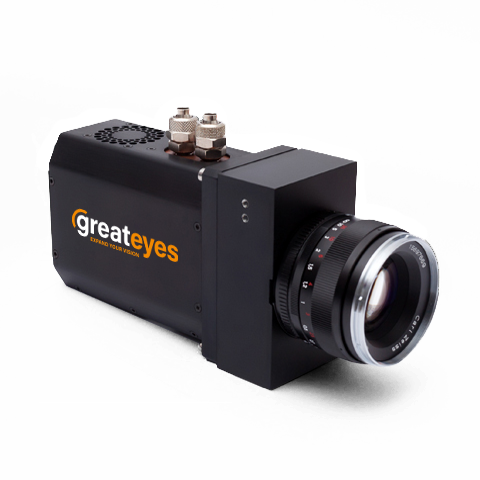
Based on a unique platform concept, greateyes offers a portfolio of scientific cameras for imaging and spectroscopy in the UV, VIS and NIR range. The deep-cooled, high-performance CCD detectors are very compact. They combine highly sensitive sensors with ultra-low noise 18-bit electronics for optimal detection of weak signals. Select among different pixel formats, several sensor technologies, and various sensor coatings to find the best solution for your imaging or spectroscopic application.
The full-frame CCD sensors are integrated in hermetically sealed vacuum chambers with multi-stage Peltier elements. The cameras provide a rich set of functionalities including fully flexible binning operation, various trigger and synchronization modes, crop and burst mode, software-selectable gain as well as temperature monitoring of the sensor and the Peltier hot side.
Pixel readout frequency
50 kHz, 100 kHz, 250kHz, 500 kHz, 1 MHz, 3 MHz (5 MHz for visualization mode)
AD convertor resolution
18 bit
Linearity
Better than 99%
Window material
UVFS (standard), MgF2, BK7, customised windows on request
Temperature monitoring
Two thermistors at CCD sensor and thermoelectric cooler (hot side)
Data link
Gigabit Ethernet, USB 3.0
Software
greateyes Vision software for Windows 10 / 11
SDK
DLL for Windows; LabVIEW, EPICS, Linux, Python, Tango driver (optional)
Drivers
EPICS, Tango, µManager
TTL interface signals
Exposure out, shutter out, 2 external trigger in
Operating conditions
Temperature: 0°C to 35°C ambient; Relative humidity: <80% (non-condensing)
Power Supply
80-264 VAC, 47-63 Hz, max. 1.1 A (230 V) / 1.9 A (115 V); 2k2k plus & 4k4k: 85-264 VAC, 47-63 Hz, max. 1.9 A (230 V) / 3.8 A (115 V)
Certification
CE
greateyes Vision software
Providing access to all camera functionalities
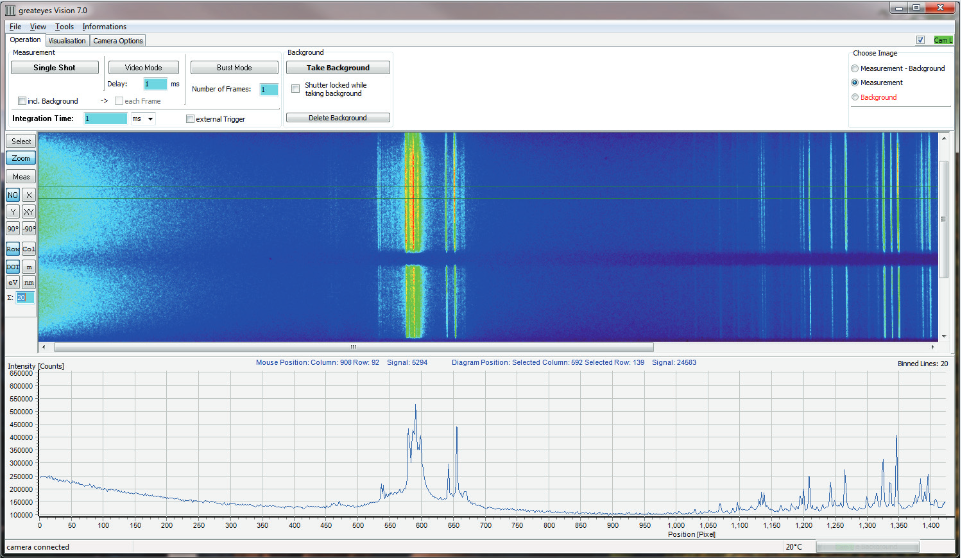
greateyes Vision software includes comprehensive visualisation, analysis and storage options, and supports important features such as wavelength and geometric calibration, crop and burst modes, and various file formats. The software runs on 32/64-bit Windows systems. For integration into other systems, a software development kit and drivers are available.
Frequently Asked Questions
ELSE cameras can be integrated into laboratory instruments, optical spectroscopy systems, research imaging setups and OEM scientific equipment. With compact camera design, hermetically sealed detector construction and ultra-deep thermoelectric cooling, ELSE cameras are suitable for demanding low-light measurements where stable detector performance, high quantum efficiency and low dark current are required.
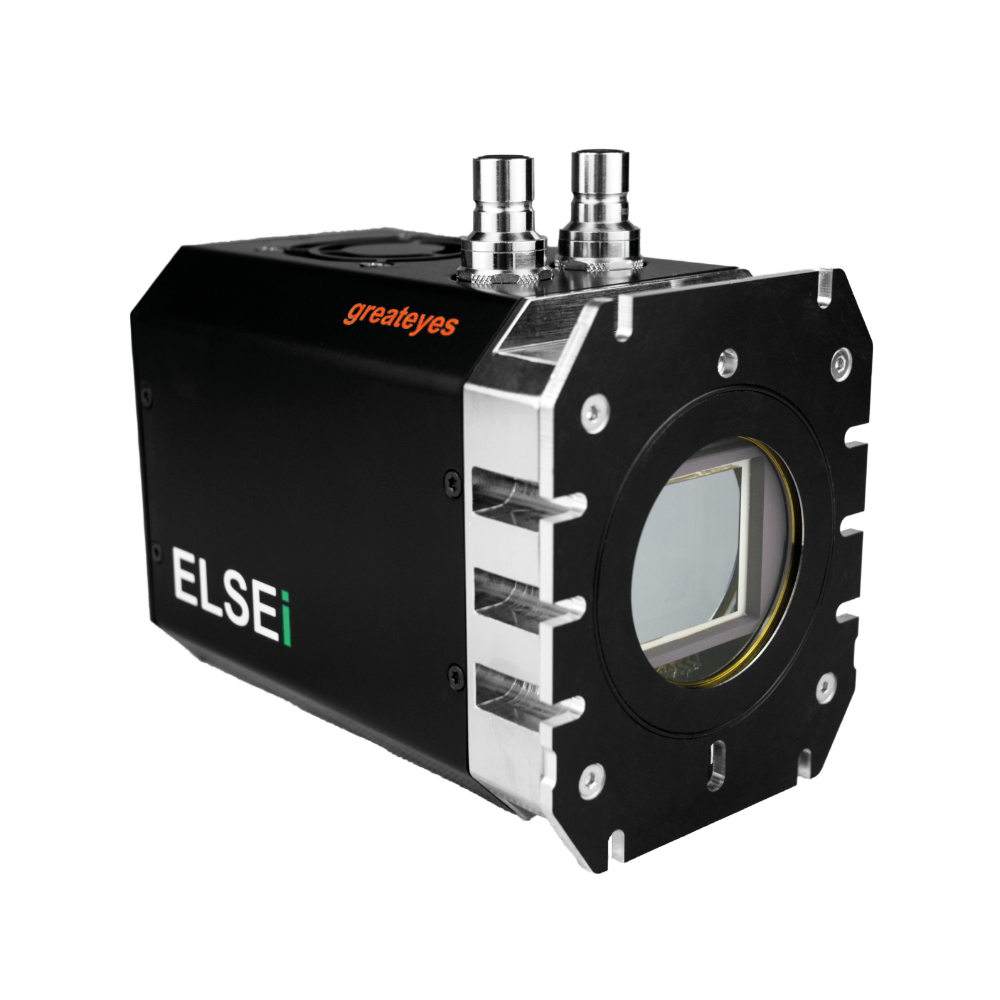
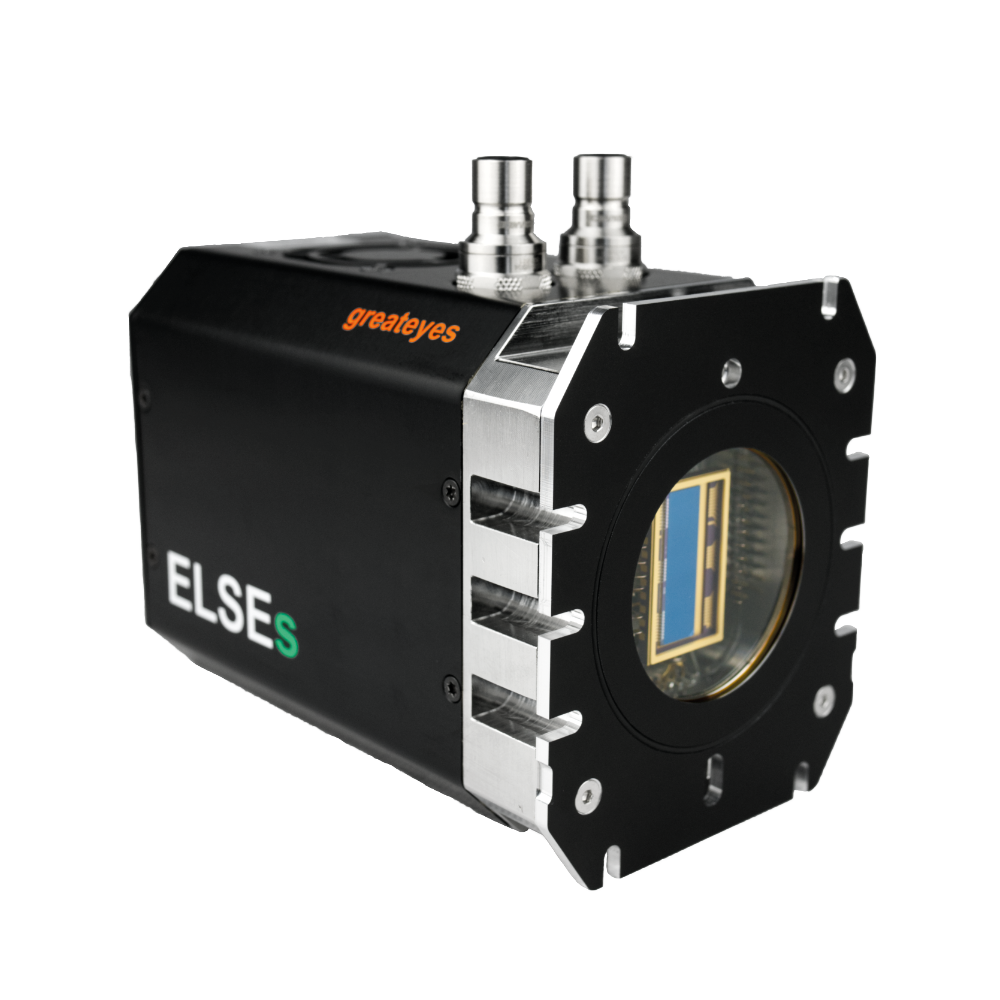
The ELSEi series provides square-format CCD sensors for scientific imaging, while the ELSEs series offers rectangular sensor formats optimized for spectroscopy. With selectable sensor pixel formats and coating options for UV, visible and near-infrared detection, ELSE cameras can be configured for a wide range of application-specific measurement tasks. GigE and USB 3.0 interfaces, greateyes Vision software and optional SDKs/drivers support integration into existing experimental or instrument-control environments.
ELSE cameras can be used across a range of scientific imaging and optical spectroscopy methods. ELSEi models provide square-format CCD sensors for imaging and applications that benefit from a two-dimensional detector format, while ELSEs models offer rectangular sensor formats optimized for spectroscopy and spectrograph-based detection.
Typical application areas include optical spectroscopy such as Raman, fluorescence, NIR, LIBS, absorption, transmission and reflectance measurements. Areas of application for scientific imaging include fluorescence bioimaging, microscopy, astronomy, neutron tomography, electroluminescence / photoluminescence imaging and imaging-based research setups used in ultracold quantum studies. With selectable sensor pixel formats and coating options for UV, visible and near-infrared detection, ELSE cameras can be configured for quantitative measurements where sensitivity, dynamic range, low dark current and stable detector performance are important.
ELSEi and ELSEs differ primarily in detector geometry, sensor format and available sensor/coating configurations. ELSEi cameras provide square-format CCD sensors for scientific imaging and applications that benefit from a two-dimensional detector area. ELSEs cameras provide rectangular CCD formats optimized for spectroscopy and spectrograph-based detection, where spectral information is recorded across the detector array.
Both series are built on the same high-performance ELSE platform, with ultra-deep thermoelectric cooling, hermetic sealing, high quantum efficiency and selectable sensor/coating options for UV, visible and near-infrared detection. The most suitable ELSE configuration for your application will depend on the specific parameters of your setup, including your optical layout, detector format, spectral range and readout requirements. Our team is happy to help select the camera model and sensor options best matched to your measurement needs.
ELSE cameras offer a high degree of configurability for application-specific scientific and OEM systems. During the standard configuration process, users select the appropriate ELSEi or ELSEs model, sensor format and sensor/coating option for their application. Available configurations support UV, visible, broadband and near-infrared detection, with front-illuminated, back-illuminated, deep-depletion and open-electrode CCD sensor options depending on the selected series and model.
For projects with additional integration requirements, we will gladly work with you to define further customizations including adaptations to detector alignment, camera housing or cooling configuration. Software, SDK and driver options are also available for integration into existing experimental or instrument-control environments. Our team is happy to help identify the best suited ELSE configuration for your setup and measurement requirements.
ELSE cameras can be integrated into scientific instruments, measurement systems and OEM platforms by matching the camera configuration to the mechanical, optical and control requirements of the setup. The selected ELSEi or ELSEs model should be chosen according to the required detector geometry, system layout, spectral range and cooling requirements. Optional lens adaptors, such as C-mount or F-mount, shutter accessories and liquid-cooling solutions are available depending on the selected camera configuration.
For system control and data transfer, ELSE cameras support GigE and USB 3.0 interfaces, TTL signals for exposure, shutter and external trigger synchronization, and are compatible with greateyes Vision software. SDKs and optional drivers, including Windows DLL, Linux, Python, LabVIEW, EPICS and Tango options, are available for integration into existing experimental or instrument-control environments. For projects with additional mechanical, cooling or OEM requirements, we will gladly work with you to define further customizations.
ELSE cameras are not intended for direct integration into customer vacuum chambers or operation as in-vacuum camera systems. Although ELSE cameras use a hermetically sealed detector design this refers to the internal camera construction, not to compatibility with integration into external vacuum systems.
In many applications, ELSE cameras can still be used with vacuum-based experiments by positioning the camera outside the vacuum environment and coupling it through suitable optics, viewports, spectrographs or instrument interfaces. Depending on the required wavelength range, detector format and integration concept, another greateyes camera line, such as ALEX, CHARLIE or LOTTE, or a project-specific solution may be more appropriate. Feel free to contact us to discuss options; we will be happy to assist.
ELSE camera speeds depend largely on the selected model, sensor format and readout mode. Standard pixel readout frequencies are 50 kHz, 250 kHz, 1 MHz and 3 MHz, with a 5 MHz visualisation mode for faster preview or alignment. ELSEi cameras can also support multi-output readout with effective readout speeds of up to 20 MHz, depending on the selected configuration.
The practical image or spectrum acquisition rate depends on the selected sensor format, readout mode and required read-noise performance. Lower readout frequencies are typically selected for lowest-noise quantitative measurements, while faster modes are useful when acquisition speed is the priority.
The main factors determining detector noise performance are the camera model, sensor configuration, operating temperature and readout speed. At low-noise readout settings (50 kHz), read noise can be as low as 2.8 e⁻ for ELSEi and 3.5 e⁻ for ELSEs. At faster readout speeds, typical read-noise values increase. A full matrix of read-noise values for different readout speeds, camera models and sensor variants can be found in our ELSE Range Brochure, available here on our website.
Effective cooling is also important for maintaining a low noise floor, especially for longer exposure times. ELSE cameras support very low dark current through ultra-deep thermoelectric cooling, down to -100°C, with dark-current values reaching the 10⁻5 e⁻/pixel/s range or below depending on the model and sensor variant, and best-case values under specific configurations reaching as low as 0.00008 e⁻/pixel/s for ELSEi and 0.00025 e⁻/pixel/s for ELSEs.
The optimum configuration of your camera will depend on your application(s), and we will be happy to assist you in choosing the right camera configuration and settings to meet your noise requirements.
ELSE cameras are available with both square-format imaging sensors and rectangular spectroscopy-oriented sensor formats. In the ELSEi series, four models are available covering square or near-square sensor resolutions from approximately 1k x 1k up to 4k x 4k. In the ELSEs series, we offer four rectangular sensor-format variants including 1k and 2k long-format sensors with smaller pixel counts in the shorter detector dimension, optimized for spectroscopy and spectrograph-based detection.
ELSEi models are available with usable pixel formats of 1024 x 1024 / 1056 x 1027, 2048 x 2052, 2048 x 2064 and 4096 x 4112 pixels. Available usable pixel formats for the ELSEs series of cameras start at 1024 x 127 for our most compact model, extending to 1024 x 255, and then to our 2k formats covering dimensions of 2048 x 264 and the wider-format 2048 x 515 pixel variant.
The active image area depends on the selected ELSEi or ELSEs model and describes the physical detector area available for imaging or spectroscopic applications. In the ELSEi series, active image areas range from 13.3 mm x 13.3 mm for the compact 1k1k model, corresponding to an approximate 18.8 mm diagonal, up to 61.4 mm x 61.4 mm for the large-format 4k4k model with an approximate 86.8 mm diagonal. The ELSEi 2k2k and 2k2k plus models provide intermediate active areas of 27.6 mm x 27.6 mm and 30.7 mm x 30.7 mm, with diagonals of approximately 39 mm and 43.4 mm, respectively.
The ELSEs series, targeted towards spectroscopy and spectrograph-based detection methods, follows a rectangular sensor format. The compact ELSEs 1k128 provides an active area of 26.6 mm x 3.3 mm, while the ELSEs 1k256 extends the shorter detector dimension to 6.7 mm. The 2k-format models provide active areas of 30.7 mm x 3.9 mm for the ELSEs 2k256 model and 27.6 mm x 6.9 mm for the wider-format ELSEs 2k512.
ELSE cameras are available with multiple CCD sensor types and anti-reflective coating options to support UV, visible, broadband and near-infrared detection. Depending on the selected ELSEi or ELSEs model, available sensor types include front-illuminated (FI), back-illuminated (BI), deep-depletion (DD), and for selected ELSEs configurations, open-electrode (OE) sensors.
The available coating options cover configurations optimized for UV sensitivity, visible and broadband detection, midband response, multiband detection and near-infrared sensitivity. This allows ELSE cameras to be matched to applications ranging from UV-sensitive measurements and high-QE visible detection to extended sensitivity in red/near-infrared spectroscopy or imaging.
As a general guide, UV-sensitive and back-illuminated options are used where short-wavelength response or high visible sensitivity is required, while deep-depletion configurations are selected for enhanced red/near-infrared sensitivity and fringe suppression. Our team will be happy to help identify the sensor and coating combination best matched to your spectral range, signal level and system requirements.
The sensitivity of ELSE cameras depends on the selected sensor type, sensor coating where applicable, spectral range and the required operating conditions of your application(s). Depending on the configuration, ELSE cameras can provide high quantum efficiency up to 98%, with sensor and coating options available for enhanced response in the UV, visible/broadband, multiband and near-infrared detection regimes.
Saturation behaviour will depend primarily on the full well capacity and gain setting of the camera, as well as exposure time required for your measurements and the incoming signal intensity. Across the ELSE range, full well capacity varies by model and sensor variant, from 75 ke⁻ for the ELSEs 2k256 camera, to 350 ke⁻ in our ELSEi 4k4k model and up to 700 ke⁻ for our highest-capacity ELSEs 1k deep-depletion configurations. Increased full well capacity allows stronger signals to be collected before saturation, while lower-noise readout and appropriate exposure settings are important for weak-signal measurements.
Overall, ELSE can be extensively configured to prioritise and/or balance maximum sensor sensitivity, high signal capacity, low noise, and extended UV or red/near-infrared response. Our team will be happy to help match the sensor format and sensor/coating configuration to your measurement requirements, and to advise on appropriate gain and readout settings for optimal camera operation.
ELSE cameras detect incoming photons with direct-detection scientific CCD sensors that convert light into electrical charge. Photons absorbed in the pixelated silicon sensor generate photoelectrons, which are collected with an accumulated charge proportional to the number of photons detected during sensor exposure. The conversion efficiency of incoming photons to collected photoelectrons is known as quantum efficiency and can be significantly enhanced, for example in cameras employing a back-illuminated (BI) sensor architecture.
The efficiency of photon-to-electron conversion can also be influenced by selection of an appropriate sensor coating for the target application, with ELSE coatings available for UV-sensitive, visible/broadband, multiband and near-infrared detection. Full well capacity is another important parameter and determines how much charge can be accumulated before the pixel saturation limit is reached; in certain camera configurations, this can be increased by opting for a deep-depletion sensor variant.
After exposure, the accumulated pixel charge is transferred through the CCD readout structure, to be converted into a voltage and then digitized by the camera electronics to produce an image or spectrum. Parameters like quantum efficiency, read noise, dark current, full well capacity and gain mode all work together to determine how sensitively photons can be detected, how much signal can be collected before pixel saturation takes place and how the measured charge is represented as digital counts.
ELSE users have several options available to optimize signal-to-noise ratio (SNR) and measurement resolution. Readout speed, exposure time, gain settings and pixel binning are all tunable parameters that can be balanced depending on the desired application and measurement requirements.
Readout speed and exposure time determine how fast data is acquired and for how long light is collected, directly influencing signal strength and read noise. Gain settings affect the scaling of the measurement signal, how collected charge is converted into digital counts, and thereby modifies system sensitivity and how much signal can be recorded before saturation.
Pixel binning refers to combining the charge from multiple adjacent pixels during readout, trading spatial or spectral resolution for increased collected signal per output (binned) pixel, and improved SNR. This can be a very useful strategy particularly in spectroscopy applications, since in a typical spectrograph setup only one axis carries spectral information, with the non-dispersive detector axis representing instead the height or width of the spectral signal.
In such a setup, vertical binning can be applied to sum the signal across the non-dispersive axis into a condensed spectrum, improving signal strength and SNR without losing wavelength information. ELSE cameras support fully flexible pixel binning, so pixel output can be controlled as needed for measurements on a case-by-case basis.
In cases of uncertainty, we will gladly support ELSE and greateyes customers to identify the right settings for specific measurements and conditions. Don’t hesitate to reach out!
ELSE cameras are designed to support ultra-deep thermoelectric cooling for low dark current and stable detector performance. Within the ELSEi series, the ELSEi 1k1k model is capable of cooling from -100°C to 20°C, while the ELSEi 2k2k, 2k2k plus and 4k4k models are specified from -90°C to 20°C. ELSEs models are capable across the board of cooling down to -100°C.
Deep cooling is particularly important for longer exposure times and low-signal measurements, where dark current can contribute to the detector noise floor. Depending on the selected model and application requirements, ELSE cameras can be supported by appropriate cooling configurations and optional cooling accessories for specific thermal and integration requirements.
Ludwig-Boltzmann-Straße 3
12489 Berlin
Germany
greateyes GmbH
Ludwig-Boltzmann-Straße 3
12489 Berlin
Germany

Ludwig-Boltzmann-Straße 3
12489 Berlin

 Powered by Bioz